
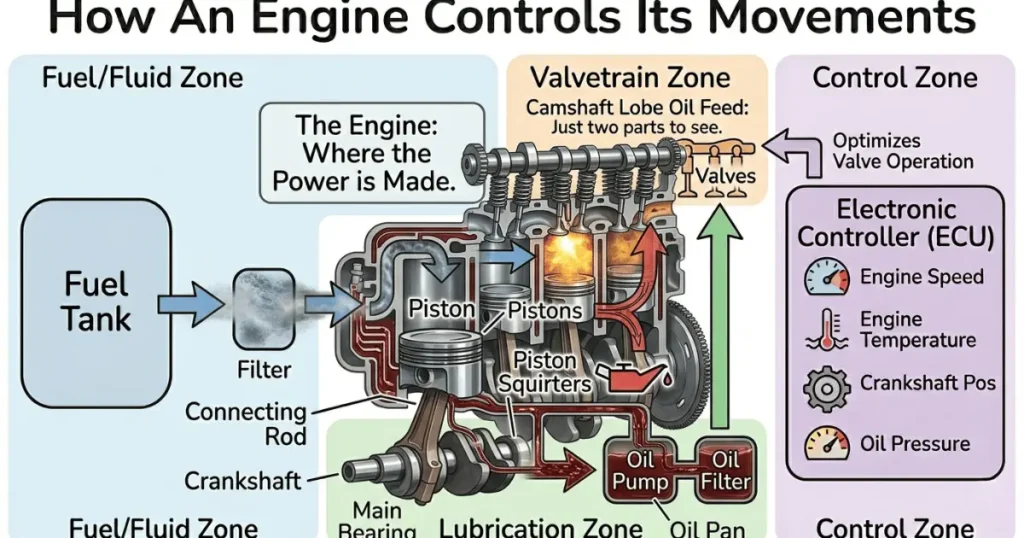
When you turn the key or press the start button in your car, something extraordinary begins to happen beneath the hood. A complex system of metal, fuel, air, and controlled explosions comes alive to generate the power that moves your vehicle. Most drivers use their cars every day without truly understanding how a car engine works, yet this machine is one of the most fascinating inventions in human engineering.
A car engine converts fuel into motion through a process known as internal combustion. It takes chemical energy stored in petrol or diesel and transforms it into mechanical energy that rotates the wheels. This process happens thousands of times per minute inside the engine, with incredible precision and timing.
In this detailed guide, you will not just learn the basic concept but deeply understand every part of the engine, how each component works, how the combustion cycle functions, and how modern technology has evolved engines to become more efficient and powerful.
The Four-Stroke Engine Cycle
Most modern car engines operate on the four-stroke cycle, which consists of four distinct stages: intake, compression, power, and exhaust. This cycle repeats continuously while the engine is running.
Intake Stroke
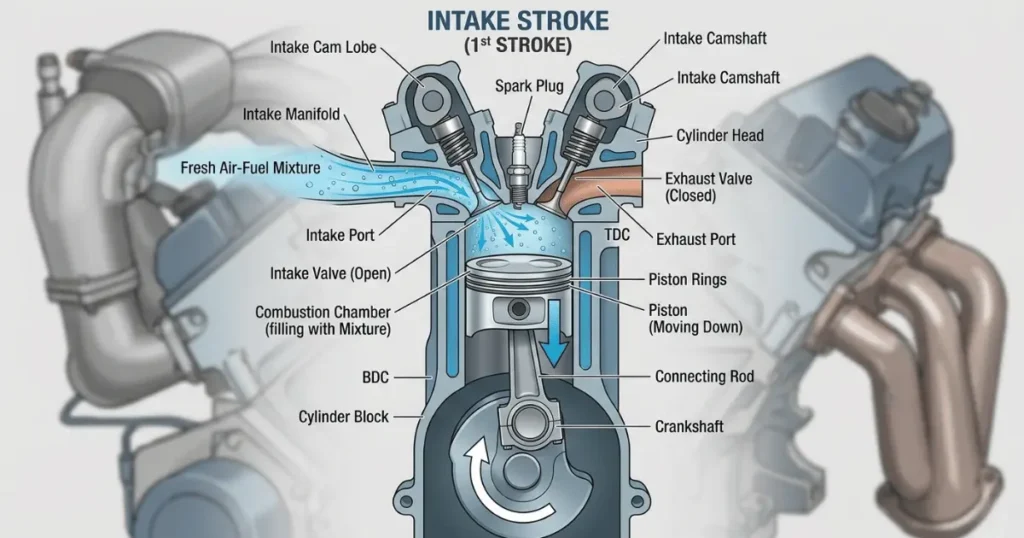
The intake stroke marks the very beginning of the power cycle in an internal combustion engine, and it plays a critical role in determining how efficiently the engine performs. During this stage, the engine actively draws in the air or the air-fuel mixture that will later be compressed and ignited to produce power. Without a properly functioning intake stroke, the entire combustion process would suffer, leading to poor performance, reduced fuel efficiency, and increased emissions.
As the intake stroke begins, the piston inside the cylinder moves downward from the top dead center (TDC) to the bottom dead center (BDC). This downward movement does not happen randomly—it occurs because the crankshaft rotates, pulling the piston down through the connecting rod. As the piston descends, it creates a low-pressure area, or vacuum, inside the cylinder. This pressure difference between the inside of the cylinder and the outside atmosphere forces air—or in petrol engines, an air-fuel mixture—into the cylinder through the intake valve.
At the same time, the intake valve opens precisely at the right moment, controlled by the camshaft. The timing of this valve operation is extremely important because it ensures that the maximum possible amount of air enters the cylinder. Engineers design this process very carefully, as better air intake leads to better combustion and more power output. In modern engines, technologies like variable valve timing further refine this process by adjusting the opening and closing of the intake valve based on engine speed and load conditions.
In petrol engines, the intake stroke allows a mixture of air and fuel to enter the cylinder. This mixture usually forms in the intake manifold or directly inside the cylinder in the case of direct injection systems. The throttle valve controls how much air enters the engine, and this directly influences engine power. When you press the accelerator pedal, the throttle opens wider, allowing more air to enter, which results in a larger air-fuel mixture and ultimately more power.
In contrast, diesel engines handle the intake stroke differently. During this phase, only fresh air enters the cylinder, without any fuel mixed in. The engine later injects fuel directly into the highly compressed air during the compression stroke. This difference explains why diesel engines do not require a throttle valve in the same way petrol engines do, and it also contributes to their higher efficiency and torque characteristics.
Another important aspect of the intake stroke is airflow quality. It is not just about how much air enters the cylinder, but also how smoothly it flows. Engineers design intake ports, valves, and manifolds to create a swirl or tumble motion in the incoming air. This motion improves the mixing of air and fuel, leading to more efficient combustion. A well-designed intake system ensures that the engine breathes properly, much like how lungs need clean and unrestricted airflow to function effectively.
compression Stroke
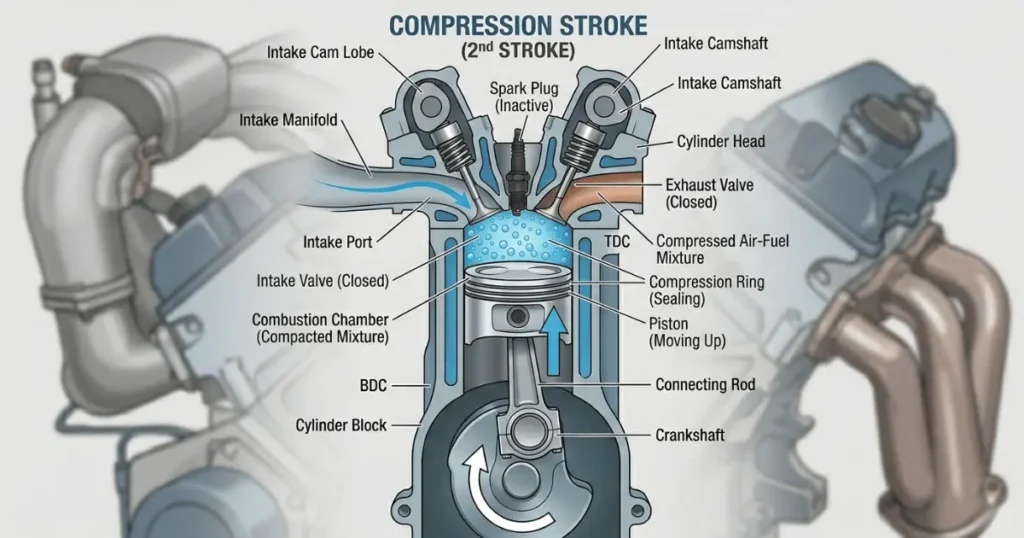
The compression stroke stands at the heart of the internal combustion process, and it plays a decisive role in how much power an engine ultimately produces. After the intake stroke fills the cylinder with air or an air-fuel mixture, the engine immediately begins compressing that charge to prepare it for ignition. This stage transforms a loosely packed mixture into a highly pressurized and energy-rich state, which allows the engine to extract maximum power during combustion.
As the compression stroke begins, the piston moves upward from bottom dead center (BDC) to top dead center (TDC). During this upward movement, both the intake valve and the exhaust valve remain completely closed. This sealing of the combustion chamber ensures that no air or fuel escapes, allowing the piston to compress everything inside the cylinder effectively. The tighter the compression, the more powerful and efficient the combustion process becomes.
When the piston rises, it reduces the volume inside the cylinder while the amount of air or air-fuel mixture remains the same. This reduction in volume causes a rapid increase in pressure and temperature. In petrol engines, the air-fuel mixture becomes highly compressed, making it more reactive and ready for ignition by the spark plug. In diesel engines, the compression process becomes even more intense, as only air is present in the cylinder at this stage. The engine compresses this air to such a high degree that its temperature rises enough to ignite diesel fuel automatically when injected.
Power stroke
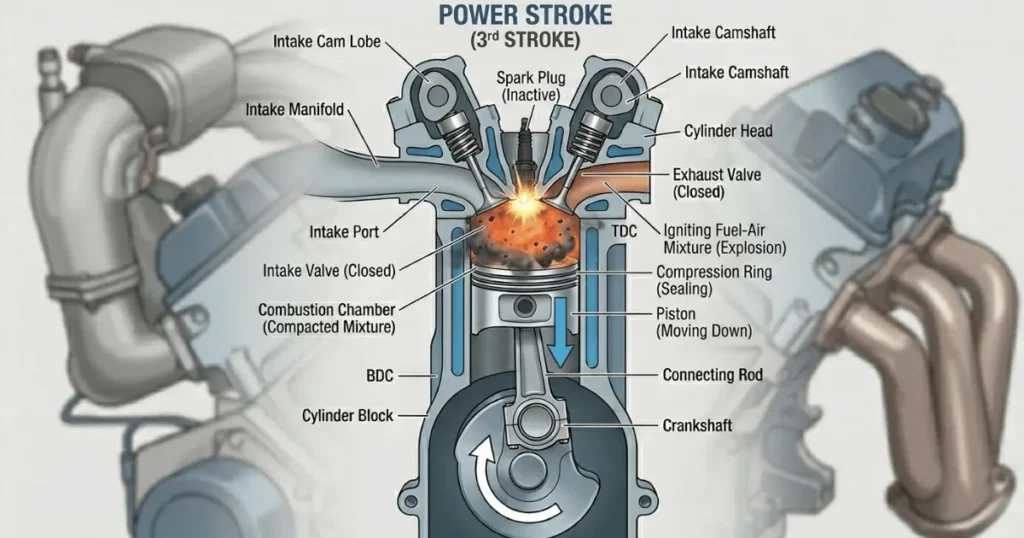
The power stroke, often called the combustion stroke, represents the most dynamic and forceful phase of an internal combustion engine. This is the moment when the engine actually produces usable power, converting chemical energy stored in fuel into mechanical energy that ultimately drives the vehicle forward. Every movement of the car, from gentle cruising to aggressive acceleration, depends on how effectively this stroke delivers force.
As the power stroke begins, the piston reaches the top dead center (TDC) at the end of the compression stroke. At this precise moment, the engine initiates combustion. In petrol engines, the spark plug ignites the highly compressed air-fuel mixture, creating a controlled explosion inside the cylinder. In diesel engines, the process works differently but achieves the same result. The engine injects fuel directly into the hot, highly compressed air, causing it to ignite spontaneously without the need for a spark plug.
This combustion process generates an immense amount of heat and pressure within a fraction of a second. The gases inside the cylinder expand rapidly, and this expansion creates a powerful force that pushes the piston downward from TDC to bottom dead center (BDC). This downward movement of the piston is not just a simple motion—it is the core action that produces mechanical work. The connecting rod transfers this force to the crankshaft, causing it to rotate. This rotation eventually turns the wheels of the vehicle through the transmission system.
The efficiency of the power stroke depends heavily on how well the combustion process occurs. A complete and well-timed burn of the air-fuel mixture produces maximum pressure at the right moment, ensuring that the piston receives the strongest possible push. Engineers carefully design ignition timing to make sure that combustion begins slightly before the piston reaches TDC, allowing peak pressure to occur just after TDC. This precise timing maximizes the force applied to the piston and improves overall engine efficiency. In modern engines, technology plays a significant role in optimizing the power stroke. Advanced fuel injection systems ensure precise delivery of fuel, while electronic control units (ECUs) continuously adjust ignition timing based on driving conditions. Turbochargers and superchargers further enhance the power stroke by increasing the amount of air entering the cylinder, which results in a more powerful combustion process.
exhaust Stroke
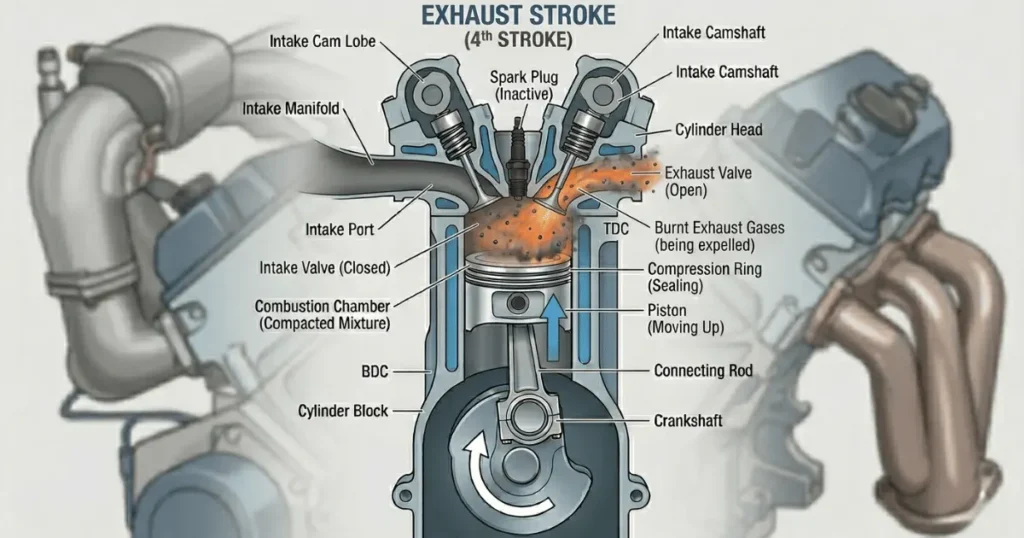
The exhaust stroke completes the four-stroke cycle of an internal combustion engine, and although it does not produce power directly, it plays a crucial role in maintaining engine efficiency and smooth operation. After the intense energy release during the power stroke, the cylinder fills with burnt gases that no longer contribute to combustion. The engine must remove these gases quickly and effectively to prepare the cylinder for the next cycle, and this is exactly what happens during the exhaust stroke.
As this stroke begins, the piston starts moving upward from bottom dead center (BDC) to top dead center (TDC). At the same time, the exhaust valve opens while the intake valve remains closed. This precise valve timing ensures that the burnt gases have a clear path to exit the cylinder. As the piston rises, it pushes the exhaust gases out through the open exhaust valve and into the exhaust manifold. This process may seem simple, but it requires careful engineering to ensure that the gases leave the cylinder as completely as possible.
The efficiency of the exhaust stroke directly affects the engine’s ability to perform in the next cycle. If some exhaust gases remain trapped inside the cylinder, they dilute the incoming fresh air or air-fuel mixture during the intake stroke. This reduces combustion efficiency, leading to lower power output and increased fuel consumption. Engineers refer to this as poor scavenging, and modern engines use advanced designs to minimize it.
Exhaust flow dynamics play a major role in this stage. As the piston pushes gases out, the design of the exhaust valve, cylinder head, and exhaust manifold influences how smoothly and quickly the gases escape. A well-designed exhaust system creates minimal resistance, allowing gases to flow freely. In high-performance engines, engineers even use the momentum of exiting gases to help pull out remaining exhaust from the cylinder, improving overall efficiency.
Although petrol and diesel engines follow the same four-stroke cycle, their working principles differ in important ways.
Diesel Engine Working
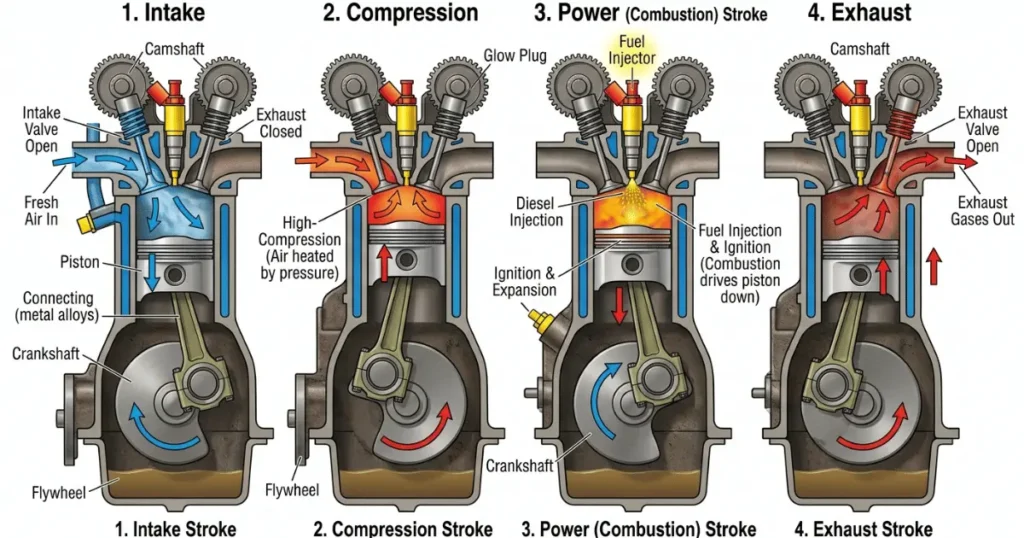
A diesel engine works on a simple yet highly efficient principle—compression ignition. Instead of relying on a spark to ignite fuel, it uses extremely high pressure to generate the heat required for combustion. This fundamental approach shapes the entire working process of the diesel engine and gives it its well-known characteristics of high torque and superior fuel efficiency.
The process begins when the engine draws only fresh air into the cylinder during the intake stroke. Unlike petrol engines, no fuel mixes with this air at this stage. As the piston moves downward, it allows a large volume of clean air to enter, preparing the cylinder for the next and most critical stage.
During the compression stroke, the piston moves upward and compresses this air to a very high degree. Diesel engines use a much higher compression ratio compared to petrol engines, and this intense compression dramatically increases the temperature of the air inside the cylinder. By the time the piston reaches the top, the air becomes extremely hot—hot enough to ignite fuel instantly.
At this precise moment, the engine injects diesel fuel directly into the hot, compressed air through a high-pressure fuel injector. The fuel does not wait for a spark; it ignites immediately upon contact with the hot air. This spontaneous combustion produces a powerful expansion of gases, forcing the piston downward with great force during the power stroke. This is where the diesel engine generates its strong pulling power, especially noticeable at low engine speeds.
Once the power stroke completes, the engine moves into the exhaust stroke. The piston rises again, pushing the burnt gases out of the cylinder through the open exhaust valve. This clears the cylinder and prepares it for the next cycle. The entire process repeats rapidly, producing a steady flow of power.
What makes the diesel engine unique is its ability to operate without a spark plug and its reliance on high-pressure systems. This design allows it to extract more energy from fuel, making it highly efficient for long-distance driving and heavy-duty applications. However, the same high-pressure environment also makes diesel engines stronger, heavier, and slightly noisier compared to petrol engines.
Petrol Engine Working
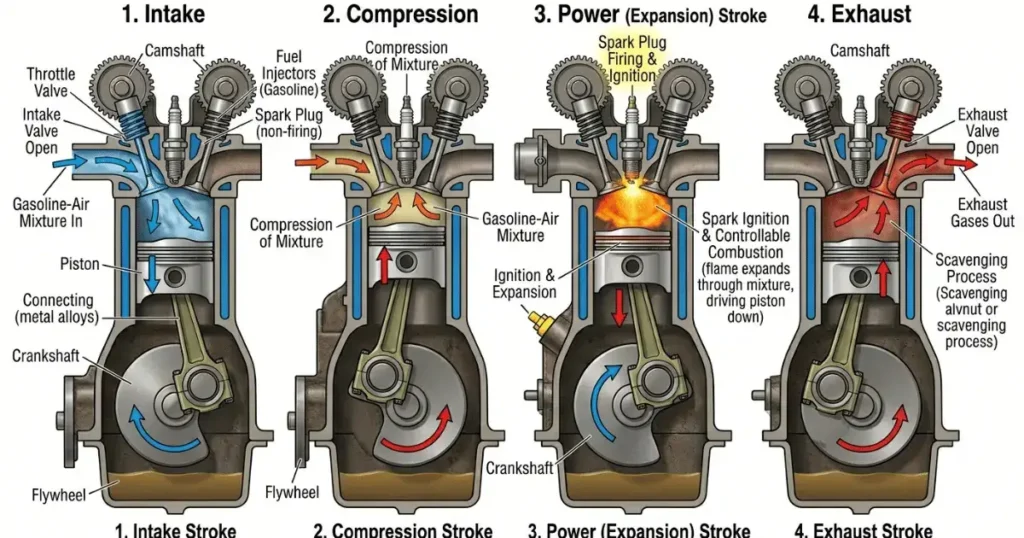
A petrol engine follows a different path to produce power, relying on spark ignition instead of compression ignition. It focuses on mixing fuel and air before combustion and controlling the ignition process with high precision. This approach results in smoother operation and quicker response, which is why petrol engines are commonly used in everyday passenger vehicles.
The working process starts with the intake stroke, where the engine draws a mixture of air and petrol into the cylinder. This mixture forms either in the intake manifold or directly inside the cylinder in modern engines. The throttle valve controls how much air enters, and this directly influences how much fuel mixes with it, determining the engine’s power output.
As the piston moves upward during the compression stroke, it compresses this air-fuel mixture. The compression ratio remains lower than that of a diesel engine to prevent premature ignition. The goal here is not to create extremely high temperatures, but to prepare the mixture for controlled ignition.
Just before the piston reaches the top, the spark plug fires and ignites the compressed mixture. This spark initiates combustion in a controlled and smooth manner. The burning gases expand rapidly, pushing the piston downward during the power stroke. Although the force generated is slightly less aggressive than in a diesel engine, it delivers a smoother and more refined driving experience.
After the power stroke, the engine enters the exhaust stroke. The piston moves upward again, expelling the burnt gases through the exhaust valve. This clears the cylinder and allows the cycle to repeat continuously.
The petrol engine stands out because of its smooth combustion and higher engine speed capability. It responds quickly to acceleration and produces less noise and vibration. However, it generally consumes more fuel compared to a diesel engine because it operates at lower compression ratios and relies on a pre-mixed air-fuel charge. temperatures but
Fuel injection System
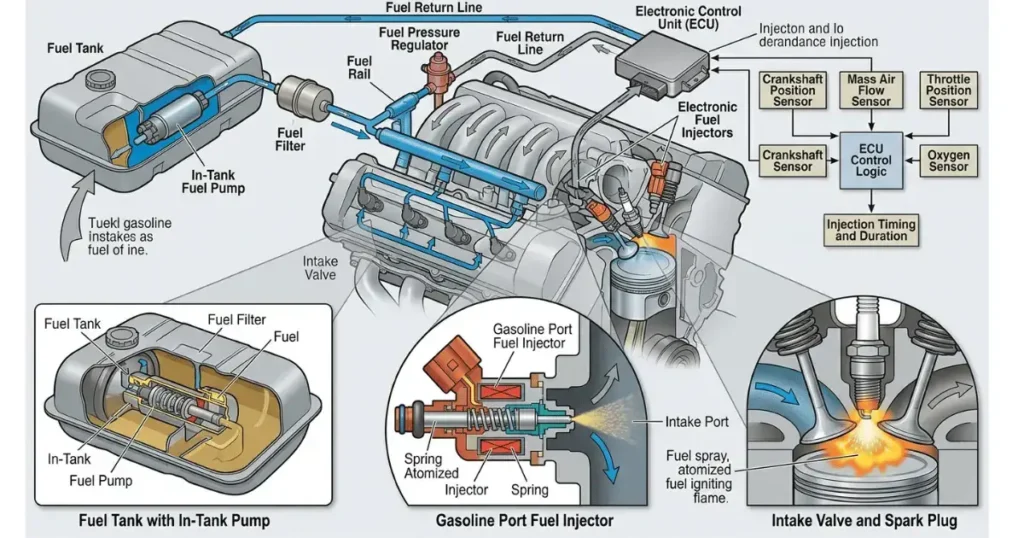
The fuel injection system acts as the heart of a modern car engine’s fuel delivery process, and it plays a decisive role in determining how efficiently the engine performs. Instead of relying on older carburetor technology, modern engines use precisely controlled injectors to deliver fuel directly into the air stream or combustion chamber. This system ensures that the engine receives the exact amount of fuel at the exact moment it needs it, which improves power, efficiency, and emissions.
At its core, the fuel injection system works by pressurizing fuel and delivering it in a fine spray into the engine. The process begins inside the fuel tank, where a fuel pump pushes fuel through fuel lines toward the engine. As the fuel travels, it passes through a filter that removes impurities, ensuring that only clean fuel reaches the injectors. Clean fuel becomes essential because even tiny particles can affect injector performance and disrupt the spray pattern.
Once the fuel reaches the engine, it enters the fuel rail, which acts as a distribution channel supplying fuel to each injector. The injectors themselves are highly precise electronic valves. They open and close rapidly, often multiple times per second, to spray fuel into the intake manifold or directly into the combustion chamber. This spray must remain extremely fine and evenly distributed so that it mixes properly with air. A well-atomized fuel mixture burns more completely, producing better power and fewer emissions.
The entire operation of the fuel injection system depends on an electronic control unit (ECU), which serves as the brain of the engine. The ECU constantly monitors various sensors, including those that measure air intake, engine temperature, throttle position, and oxygen levels in the exhaust. Based on this data, it calculates the ideal amount of fuel required for combustion and adjusts the injector timing and duration accordingly. This real-time adjustment allows the engine to adapt instantly to changing driving conditions, whether you are idling in traffic or accelerating on a highway.
Fuel injection systems vary depending on engine design, but they generally fall into two main categories: port fuel injection and direct injection. In port fuel injection systems, the injectors spray fuel into the intake manifold just before it enters the cylinder. This method allows fuel to mix with air before reaching the combustion chamber, resulting in smoother operation. In direct injection systems, the injectors spray fuel directly into the combustion chamber at very high pressure. This approach improves efficiency and power by allowing more precise control over the combustion process.
Diesel engines use an even more advanced version known as the common rail direct injection system. In this setup, fuel remains under extremely high pressure inside a shared rail, and injectors deliver it directly into the cylinder with exceptional precision. This system allows multiple injections within a single combustion cycle, improving efficiency, reducing noise, and lowering emissions.
Pressure plays a crucial role in the effectiveness of the fuel injection system. Higher pressure allows fuel to break into finer droplets, which mix better with air and burn more efficiently. Modern engines often use very high-pressure systems, especially in direct injection setups, to maximize performance and fuel economy.
The fuel injection system also contributes significantly to engine reliability and environmental performance. By delivering the correct fuel quantity, it prevents issues like incomplete combustion, which can lead to carbon deposits and increased pollution. Advanced systems also work alongside emission control technologies, ensuring that the engine meets strict environmental standards.
In real-world driving, the fuel injection system operates continuously and adapts instantly to your inputs. When you press the accelerator, the ECU commands the injectors to deliver more fuel, increasing engine power. When you drive at a steady speed, the system reduces fuel supply to conserve energy. This precise control makes modern engines more responsive, efficient, and cleaner than ever before.
Cooling System
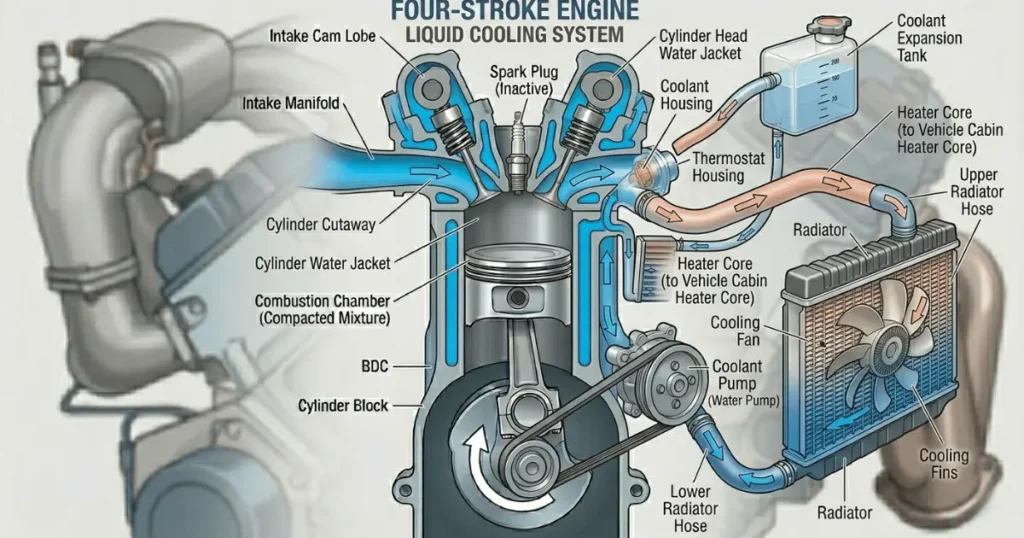
A car engine produces an enormous amount of heat every time it runs. When fuel burns inside the cylinders, the temperature rises to extreme levels, often exceeding 2,000 degrees Celsius. If the engine does not control this heat, metal components begin to expand, oil loses its lubrication ability, and eventually the engine can seize or suffer permanent damage. The cooling system takes responsibility for maintaining an optimal operating temperature so the engine can perform efficiently, safely, and consistently.
The cooling system works as a continuous heat management cycle rather than a one-time process. It circulates a special liquid called coolant through passages inside the engine block and cylinder head. This coolant absorbs heat directly from the engine components. Once it collects enough heat, it travels toward the radiator, where the system releases that heat into the surrounding air. After cooling down, the fluid returns to the engine to repeat the process. This cycle continues as long as the engine runs, ensuring that temperature remains stable even during long drives or heavy loads.
At the heart of this system, the radiator plays a crucial role in dissipating heat. It consists of thin metal fins and tubes that maximize surface area. As hot coolant enters the radiator, air passes through these fins either due to vehicle motion or with the help of a cooling fan. This airflow removes heat from the coolant, reducing its temperature before it re-enters the engine. Without an efficient radiator, the entire cooling system would fail to release heat effectively.
The water pump keeps the coolant moving throughout the system. It operates mechanically, usually driven by a belt connected to the engine. As the pump rotates, it pushes coolant through the engine passages, radiator, and hoses. This continuous circulation ensures that no part of the engine remains overheated for too long. If the pump fails, coolant flow stops, and the engine temperature rises rapidly, often leading to overheating within minutes.
The thermostat acts as a smart temperature regulator. It does not allow coolant to flow to the radiator immediately after the engine starts. Instead, it keeps the coolant within the engine until it reaches an ideal operating temperature. Once the temperature crosses a specific threshold, the thermostat opens and allows coolant to flow into the radiator. This mechanism helps the engine warm up quickly and operate efficiently, especially during cold starts.
The cooling fan supports the radiator, especially when the car moves slowly or remains stationary in traffic. At high speeds, natural airflow cools the radiator effectively. However, in city driving conditions, the fan pulls air through the radiator to maintain proper cooling. Modern cars often use electric fans that activate automatically based on engine temperature, ensuring precise control.
Coolant itself plays a vital role beyond simply carrying heat. It consists of a mixture of water and antifreeze, usually ethylene glycol. This mixture raises the boiling point and lowers the freezing point of the liquid, allowing the system to function in extreme weather conditions. It also contains additives that prevent corrosion and scale formation inside the engine and radiator, extending the lifespan of components.
The system also includes hoses, expansion tanks, and pressure caps that maintain proper circulation and pressure. The pressure cap increases the boiling point of the coolant by maintaining system pressure, which prevents vapor formation and improves heat transfer efficiency. The expansion tank allows coolant to expand and contract as temperatures change, preventing overflow and maintaining a consistent level inside the system.
In real driving conditions, the cooling system constantly adapts to different situations. When you accelerate hard, climb a hill, or carry heavy loads, the engine generates more heat. The system responds by increasing coolant flow and fan activity. On the other hand, during light driving or cold weather, it reduces cooling intensity to maintain efficiency. This balance ensures that the engine neither overheats nor runs too cold, as both conditions can negatively affect performance and fuel economy.
Over time, the cooling system requires proper maintenance to function effectively. Coolant can degrade, hoses can crack, and components like the thermostat or water pump can wear out. Regular inspection and timely replacement of coolant help prevent overheating issues. Ignoring these aspects often leads to common problems such as engine overheating, reduced efficiency, or even complete engine failure.
Lubrication System
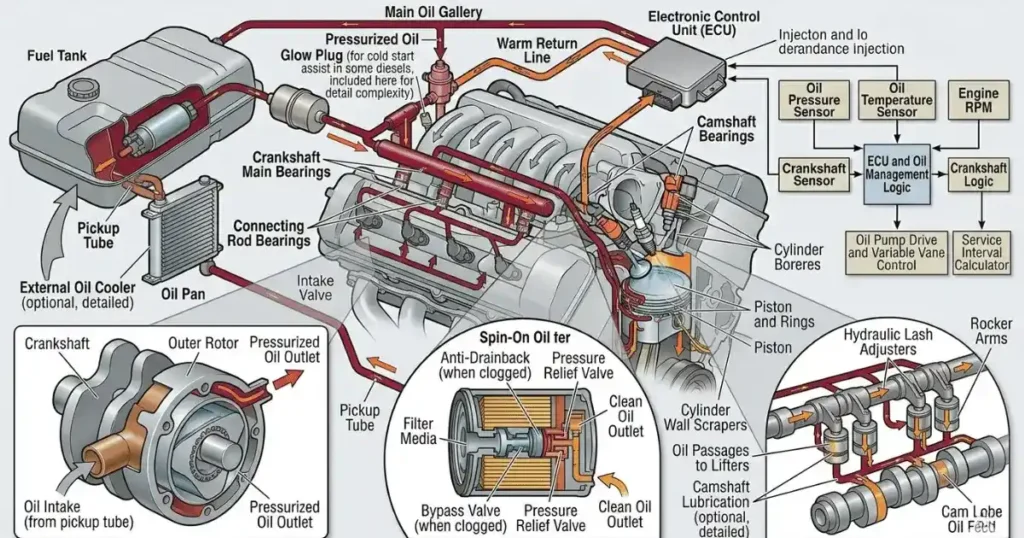
The lubrication system of a car engine plays a critical role in keeping the engine running smoothly, efficiently, and for a longer lifespan. Inside an engine, multiple metal components move at extremely high speeds and under intense pressure. Parts such as the crankshaft, camshaft, pistons, and connecting rods constantly rub against each other. If these components operate without proper lubrication, they would generate excessive friction, leading to rapid wear, overheating, and ultimately engine failure. The lubrication system prevents this by supplying a continuous flow of clean oil to all moving parts.
At the heart of the system lies the engine oil, which acts as a protective film between metal surfaces. This oil not only reduces friction but also absorbs heat, cleans internal components, and protects against corrosion. The entire process begins when the engine starts and the oil pump becomes active. The oil pump draws oil from the oil sump, which is essentially a reservoir located at the bottom of the engine. This sump stores the engine oil when it is not circulating.
Once the pump draws oil from the sump, it pushes it under pressure through the oil filter. The oil filter removes dirt, metal particles, and other contaminants that may have accumulated in the oil. Clean oil is essential because even tiny particles can cause damage to engine components over time. After filtration, the oil flows through a network of passages known as oil galleries. These galleries are carefully designed channels inside the engine block that direct oil to various components.
The pressurized oil reaches critical parts such as the crankshaft bearings, camshaft bearings, and connecting rod bearings. As the crankshaft rotates, oil forms a thin film between the moving surfaces, preventing direct metal-to-metal contact. This hydrodynamic lubrication significantly reduces wear and allows smooth rotation even at high speeds. The pistons and cylinder walls also receive lubrication, either through direct oil flow or through splash lubrication, where oil is sprayed or splashed onto surfaces by moving components.
In addition to reducing friction, the lubrication system also plays an important role in cooling the engine. While the cooling system handles most of the heat, engine oil absorbs a considerable amount of heat generated by friction. It carries this heat away from critical areas and dissipates it as the oil returns to the sump. This helps maintain optimal operating temperatures and prevents overheating.
Another important function of the lubrication system is cleaning. As oil circulates, it picks up carbon deposits, sludge, and microscopic debris from engine components. These impurities are then trapped by the oil filter, ensuring that clean oil continues to circulate. Over time, however, the oil itself becomes degraded and contaminated, which is why regular oil changes are necessary to maintain engine health.
The lubrication system also provides a sealing function, particularly between the piston rings and cylinder walls. The thin layer of oil helps seal the combustion chamber, preventing the leakage of gases and maintaining engine compression. This improves engine efficiency and performance.
Modern engines often use advanced lubrication techniques such as pressure lubrication systems, where oil is delivered under controlled pressure to ensure consistent performance under all operating conditions. Some high-performance engines also include oil coolers to further regulate oil temperature, especially under heavy loads or high-speed driving.
Actual Working Process of a Car Engine
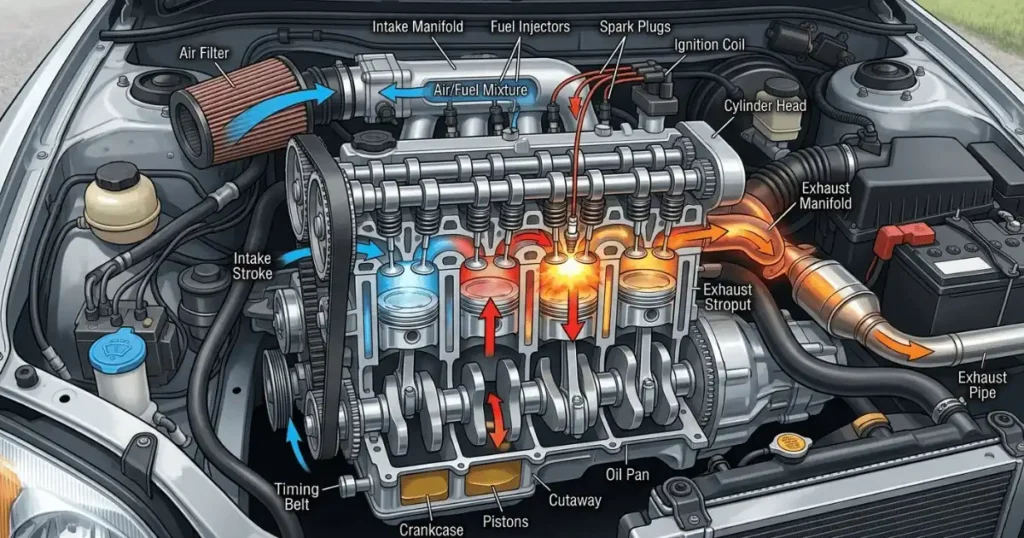
The actual working process of a car engine is a continuous, precisely timed sequence of events where fuel is converted into motion through controlled combustion. To understand this deeply, imagine what happens inside a single cylinder of an engine from the moment the engine starts running.
When you start the engine, the crankshaft begins to rotate, either through a starter motor or initial ignition. This rotation immediately causes the piston inside the cylinder to begin moving up and down. The entire working process depends on this synchronised movement between the piston, valves, and crankshaft, all controlled with extreme precision.
The cycle begins as the piston moves downward from the top of the cylinder. At this exact moment, the intake valve opens. Because the piston is moving down, it creates a vacuum inside the cylinder. This vacuum pulls in a carefully measured mixture of air and fuel. This mixture does not randomly enter the cylinder; the engine management system ensures the correct ratio so that combustion can happen efficiently. The cylinder fills with this mixture as the piston reaches the bottom of its travel.
As soon as the piston reaches the lowest point, the intake valve closes. Now the piston begins to move upward. This upward movement compresses the air-fuel mixture into a much smaller space inside the combustion chamber. Compression is a critical part of the engine’s working process because it increases both the temperature and pressure of the mixture. The tighter the mixture is compressed, the more powerful the explosion will be when ignition occurs. During this phase, both the intake and exhaust valves remain completely closed, sealing the chamber.
Just before the piston reaches the top again, the ignition process takes place. In a petrol engine, the spark plug generates a high-voltage spark. This spark ignites the compressed air-fuel mixture instantly. The ignition is not a slow burn; it is a rapid and controlled explosion. This explosion creates a sudden rise in pressure and temperature inside the cylinder.
This high-pressure force pushes the piston downward with great intensity. This downward movement is the only stage where actual power is generated in the engine. The piston is connected to the crankshaft through a connecting rod, so as the piston is forced down, it rotates the crankshaft. This rotation is what ultimately drives the wheels of the car. The more powerful the combustion, the stronger the force applied to the piston, and the more power the engine produces.
As the piston reaches the bottom again after the power stroke, the exhaust valve opens. Now the piston begins to move upward once more. This upward movement pushes the burnt gases out of the cylinder through the exhaust valve. These gases are the result of the combustion process and must be removed to make space for the next cycle. Once the gases are expelled, the exhaust valve closes.
Immediately after this, the intake valve opens again, and the entire process repeats. This cycle happens continuously and extremely fast. In a typical car engine running at around 3000 RPM, each piston completes this cycle 25 times per second. Multiply this by the number of cylinders, and you can understand how rapidly and smoothly the engine generates power.
What makes this process even more impressive is the level of synchronisation involved. The opening and closing of valves are controlled by the camshaft, which is connected to the crankshaft through a timing chain or belt. This ensures that valves open and close at the exact right moment relative to piston movement. Even a slight mismatch in timing can disrupt the entire process and reduce engine efficiency or cause damage.
Another critical aspect of the working process is fuel delivery. Modern engines use fuel injectors that spray fuel into the intake air or directly into the combustion chamber. The timing, pressure, and quantity of this fuel injection are controlled electronically to ensure optimal combustion. This precision allows the engine to produce maximum power while minimising fuel consumption and emissions.
Temperature control also plays a crucial role in the engine’s working process. As combustion occurs repeatedly, the engine generates a massive amount of heat. The cooling system ensures that the engine operates within a safe temperature range, preventing overheating and maintaining efficiency. At the same time, lubrication ensures that all moving parts operate smoothly without excessive friction.
The entire working process is not just about producing power; it is about doing so efficiently, reliably, and continuously. Every component inside the engine contributes to maintaining this cycle without interruption. From the intake of air and fuel to the expulsion of exhaust gases, each step is part of a perfectly coordinated system.
In essence, a car engine works by repeating this combustion cycle thousands of times per minute, converting chemical energy into mechanical motion. This continuous process is what allows a vehicle to move smoothly, respond to acceleration, and perform under different driving conditions.