
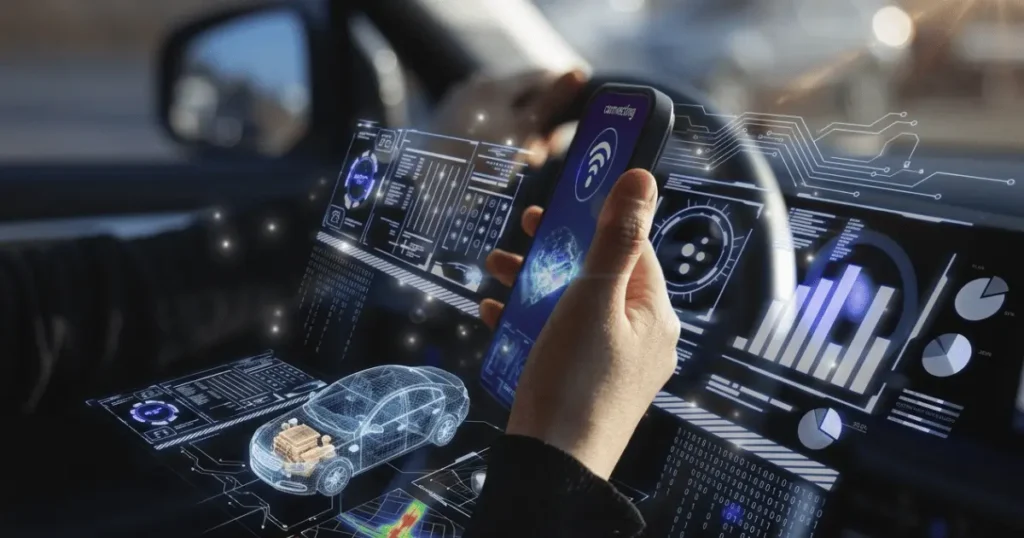
The automotive world is undergoing a transformation so profound that it is changing the very definition of a car. For more than a century, vehicles evolved through mechanical improvements—better engines, stronger chassis, and improved fuel efficiency. But in the last decade, something far more disruptive has taken centre stage: connected car technology.Today, a car is no longer just a product; it is a platform. It behaves like a smartphone on wheels, constantly connected, continuously learning, and always communicating. This shift has not only changed how cars function but also how people perceive ownership, safety, convenience, and even status.In India, this transformation feels especially significant. A country that once focused purely on affordability now demands intelligence, connectivity, and digital integration. Buyers no longer ask only about mileage and engine power; they want app-based control, real-time navigation, voice assistants, and remote diagnostics. Connected car technology has moved from being a luxury feature to a necessity in a surprisingly short time.
What exactly is Connected Car technology?
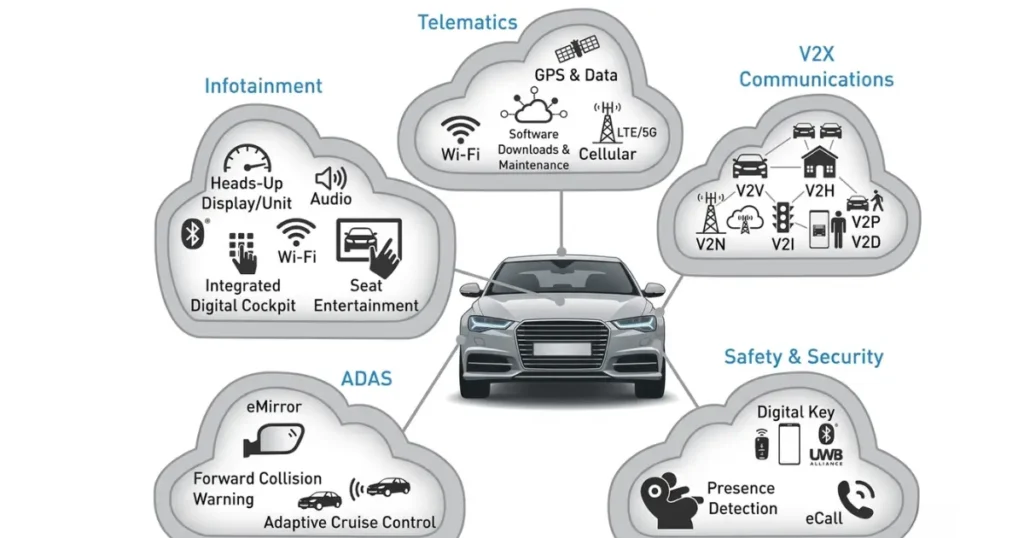
Connected car technology refers to a system in which a vehicle connects to the internet and communicates with external systems such as cloud servers, smartphones, other vehicles, and infrastructure. This connectivity allows the car to send and receive data continuously, creating a dynamic ecosystem around the vehicle.At a deeper level, a connected car acts as a data generator. Every time you drive, your car collects hundreds of data points—speed, braking patterns, fuel consumption, GPS location, engine health, and even driver behaviour. This data travels to cloud servers where it gets processed and transformed into useful insights.When you check your car’s location on your phone, receive a service alert, or get a real-time traffic update, you are experiencing the output of this complex system. The car is not just reacting; it is predicting, analysing, and assisting.At its core, connected car technology relies on a combination of embedded sensors, telematics control units (TCUs), high-speed mobile networks such as 4G and 5G, and cloud computing systems. The vehicle collects data from various components—engine performance, location, speed, fuel efficiency, and driver behavior—and transmits this information to cloud servers. In return, it receives useful insights, updates, and commands that enhance functionality, safety, and convenience.
The core architecture
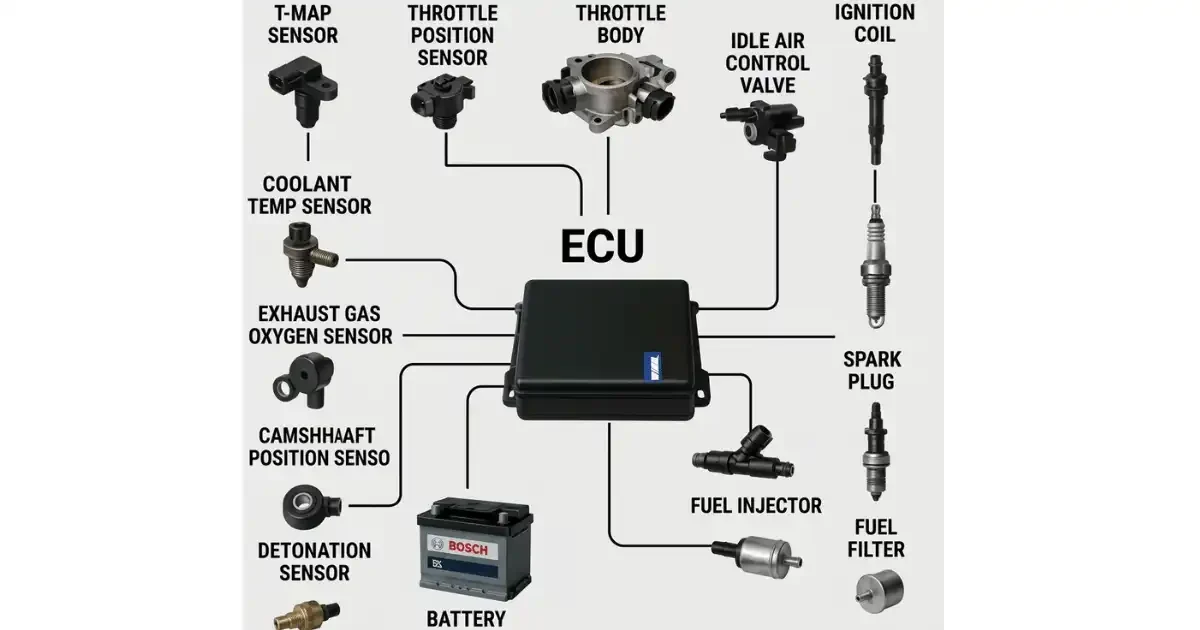
To truly understand connected car technology, you need to go beyond features and explore its architecture. This ecosystem operates through a tightly integrated combination of hardware, software, and network infrastructure.
Inside every connected car, multiple sensors continuously monitor different systems. These include engine sensors, tyre pressure monitors, cameras, radar systems, and sometimes even LiDAR in advanced vehicles. All these sensors feed data into Electronic Control Units (ECUs), which act as mini-computers managing specific functions.The Telematics Control Unit (TCU) serves as the communication hub. It connects the car to external networks using SIM cards, much like a smartphone. This is what enables internet connectivity.On the software side, advanced algorithms process data and deliver insights. Cloud computing plays a critical role here, as it stores massive volumes of data and enables real-time analysis. Artificial intelligence further enhances this system by learning patterns and improving decision-making over time.At the foundation of this architecture lies a dense network of sensors and electronic control units (ECUs). Sensors continuously capture data from every part of the vehicle—engine temperature, wheel speed, fuel levels, braking force, steering input, and even cabin conditions. Each ECU acts as a small computer dedicated to a specific function, such as engine management, transmission control, or safety systems like airbags and ABS. These ECUs communicate with each other through in-vehicle networks such as CAN (Controller Area Network), LIN, or Ethernet. This internal communication layer ensures that all systems remain synchronized and responsive to driver inputs and road conditions.
Sitting above this internal network is the telematics control unit (TCU), which acts as the central communication gateway of the connected car. The TCU collects data from various ECUs and sensors, processes it, and transmits it to external networks using cellular connectivity like 4G or 5G. At the same time, it receives incoming data from cloud servers, mobile apps, or infrastructure systems and distributes it back to the relevant components inside the vehicle. In many ways, the TCU functions like the brain’s communication hub, linking the car’s internal intelligence with the digital world outside.
Types of Connectivity
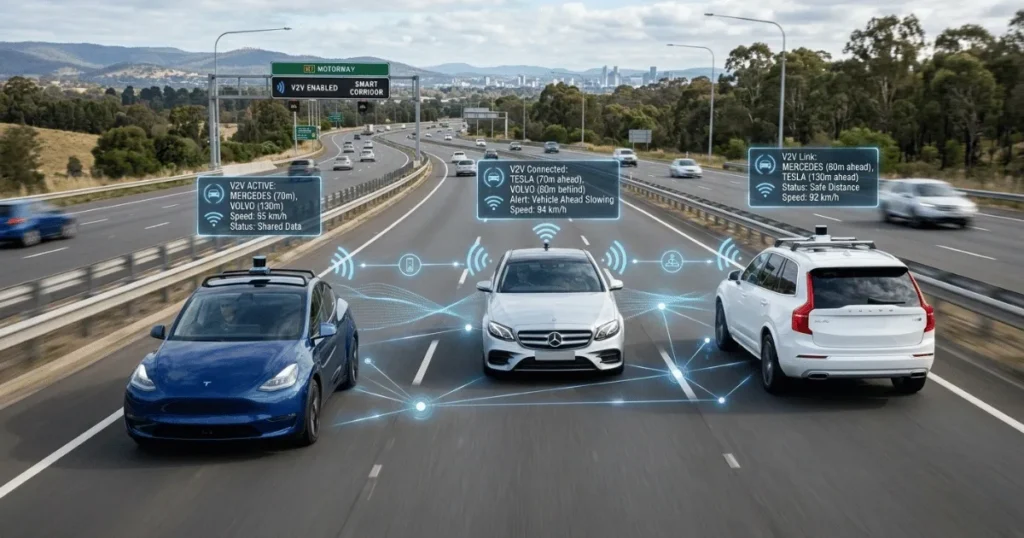
Connected car technology operates through multiple layers of connectivity, each serving a unique purpose. These layers create a comprehensive communication network that enhances functionality.Vehicle-to-vehicle communication allows cars to share information such as speed and position with each other. This helps prevent accidents by providing early warnings.Vehicle-to-infrastructure connectivity enables interaction with traffic signals, toll booths, and road systems. For example, a smart traffic signal can adjust timing based on traffic flow
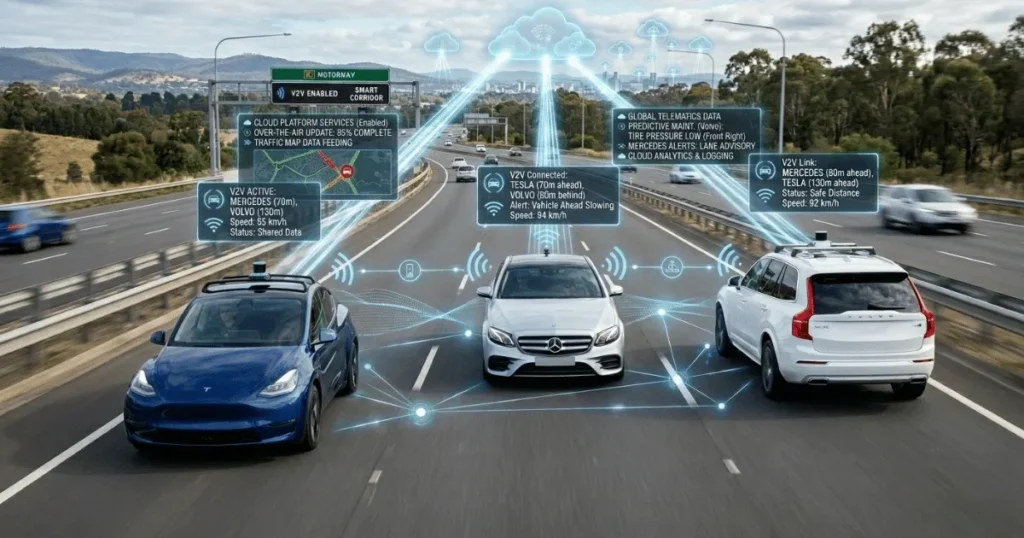
Vehicle-to-cloud communication ensures that all data gets stored and analysed remotely. This supports features like navigation, diagnostics, and updates.Vehicle-to-smartphone integration allows users to control and monitor their cars through mobile apps, creating a seamless digital experience.At the most immediate level, the car connects directly with personal devices through short-range communication technologies such as Bluetooth and Wi-Fi. This layer focuses on convenience and user interaction. When a driver pairs a smartphone with the car, the system enables hands-free calling, wireless music streaming, contact synchronization, and app integration. Wi-Fi hotspots inside the vehicle allow passengers to access the internet using the car’s data connection. This layer feels personal and interactive because it directly links the driver’s digital life with the vehicle’s interface, turning the infotainment system into an extension of the smartphone.Moving one level deeper, the car connects to external networks through cellular connectivity, typically powered by 4G LTE or increasingly 5G technology. This layer acts as the backbone of connected car functionality. Through cellular communication, the vehicle continuously exchanges data with cloud servers. It sends information such as location, diagnostics, and driving patterns and, in return, receives navigation updates, traffic data, weather conditions, and remote commands. This connection allows features like remote engine start, vehicle tracking, and real-time alerts. Unlike short-range communication, this layer operates independently of the driver’s phone, ensuring that the car remains connected even when no personal device is present.Another crucial layer involves cloud connectivity, where the vehicle becomes part of a much larger digital ecosystem. The cloud does more than just store data; it processes and analyzes it. When the car uploads information, cloud platforms apply algorithms and machine learning to generate insights. These insights return to the vehicle in the form of smarter navigation, predictive maintenance alerts, and performance optimization. This layer gives the car the ability to “learn” and improve over time, making it more efficient and responsive with continued use.
Key Features That Define Connected Cars
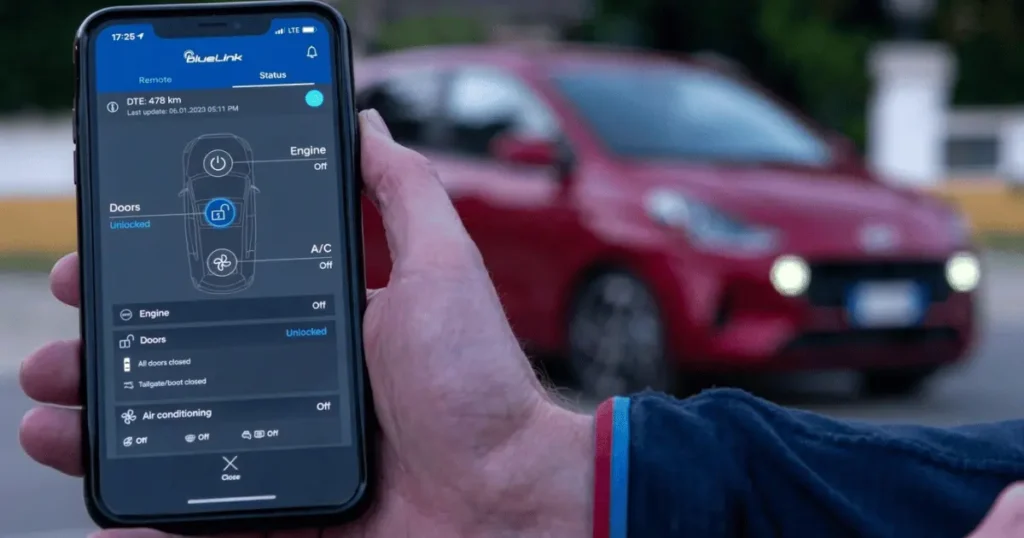
Connected car technology offers a wide range of features, but what makes it truly powerful is how these features work together to create a seamless experience. Remote access has become one of the most widely used capabilities. A driver can lock or unlock the car, start the engine, switch on climate control, or locate the vehicle using a smartphone.Navigation systems have evolved from static maps to intelligent platforms that analyse live traffic, weather conditions, and even driver preferences. The system does not just show the route; it suggests the best possible route in real time.Predictive maintenance represents another major advancement. Instead of waiting for a breakdown, the system identifies potential issues in advance. It can alert the driver about battery health, brake wear, or engine problems before they escalate.Infotainment systems have also become more advanced, integrating voice assistants, music streaming, and smartphone mirroring through Android Auto and Apple CarPlay. The car has effectively become an extension of the user’s digital life.One of the most defining features is advanced infotainment and seamless smartphone integration. Modern connected cars offer large, high-resolution touchscreens that act as the control center for navigation, media, and communication. Drivers can connect their smartphones and access apps, music, messages, and calls directly through the car’s interface. Voice recognition systems further enhance this experience by allowing drivers to control functions without taking their hands off the steering wheel. This feature transforms the cabin into a connected digital space where entertainment and information are always within reach.
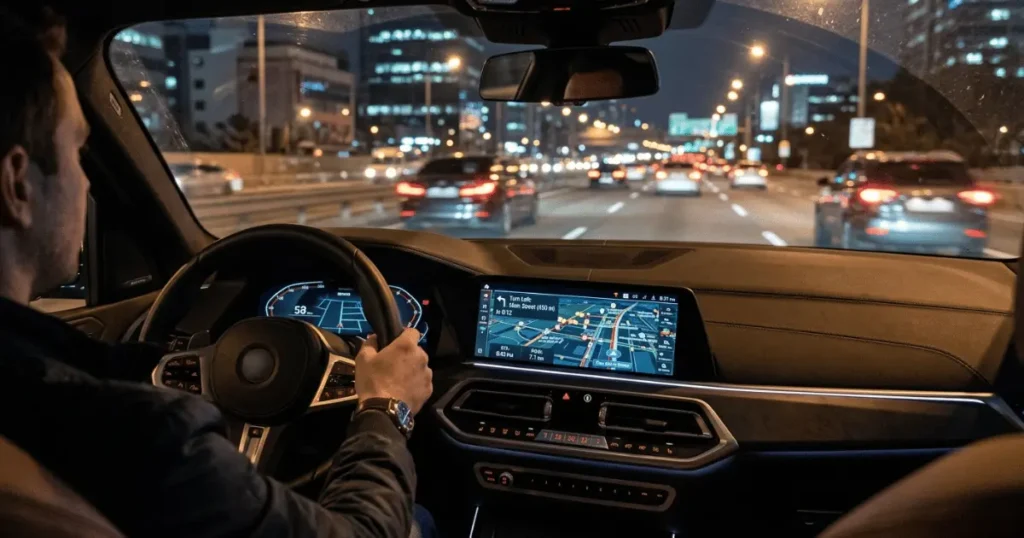
Real-time navigation and intelligent route management stand out as another core capability. Connected cars continuously receive live traffic updates, road conditions, and even weather information. The system processes this data instantly and suggests the most efficient routes, helping drivers avoid congestion and delays. It can also predict travel times with impressive accuracy, making daily commutes and long journeys more efficient and less stressful.
Remote access and control redefine how drivers interact with their vehicles. Through dedicated mobile applications, users can lock or unlock doors, start or stop the engine, adjust climate settings, and even locate their car from anywhere. This feature adds both convenience and security, especially in situations where the driver is not physically near the vehicle. It creates a sense of continuous connection, as if the car were always within reach.
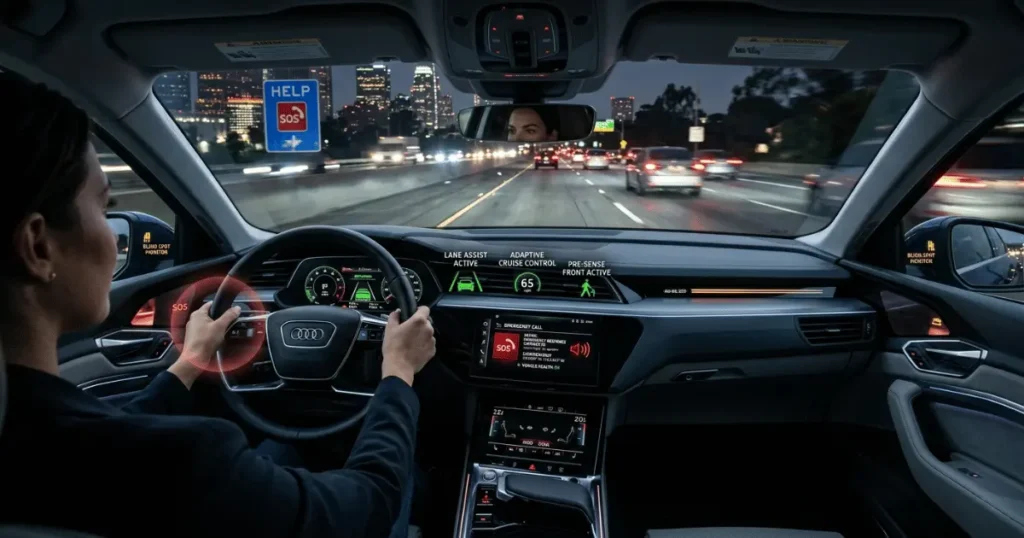
Safety and emergency response systems play a critical role in connected car technology. These vehicles can automatically detect accidents and send alerts to emergency services with precise location details. Some systems also notify selected contacts in case of an emergency. Additionally, connected cars provide real-time warnings about potential hazards, such as sudden braking by vehicles ahead or dangerous road conditions. These proactive safety features significantly reduce risks and improve overall driving confidence.
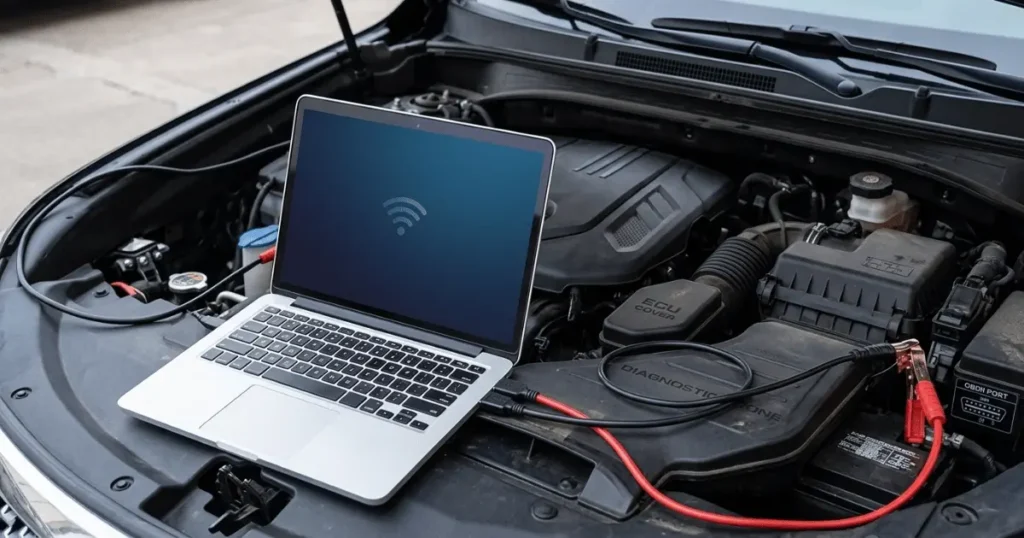
Predictive maintenance and vehicle health monitoring represent another major advancement. Instead of relying on scheduled service intervals, connected cars continuously analyze the condition of critical components. They can detect early signs of wear or malfunction and alert the driver before a serious issue arises. This not only prevents unexpected breakdowns but also helps reduce maintenance costs over time. In many cases, service centers can remotely diagnose problems, making repairs faster and more efficient.Over-the-air (OTA) updates highlight how connected cars evolve beyond traditional vehicles. Manufacturers can send software updates directly to the car, improving performance, fixing bugs, or introducing new features without requiring a visit to a service center. This capability ensures that the vehicle remains up to date with the latest technology throughout its lifecycle, much like a smartphone receiving regular updates.Another defining feature is data-driven personalization. Connected cars learn from driver behavior, preferences, and habits over time. They can automatically adjust seat positions, climate settings, music choices, and even driving modes based on individual preferences. This level of personalization creates a more comfortable and tailored driving experience, making the car feel uniquely adapted to its owner.
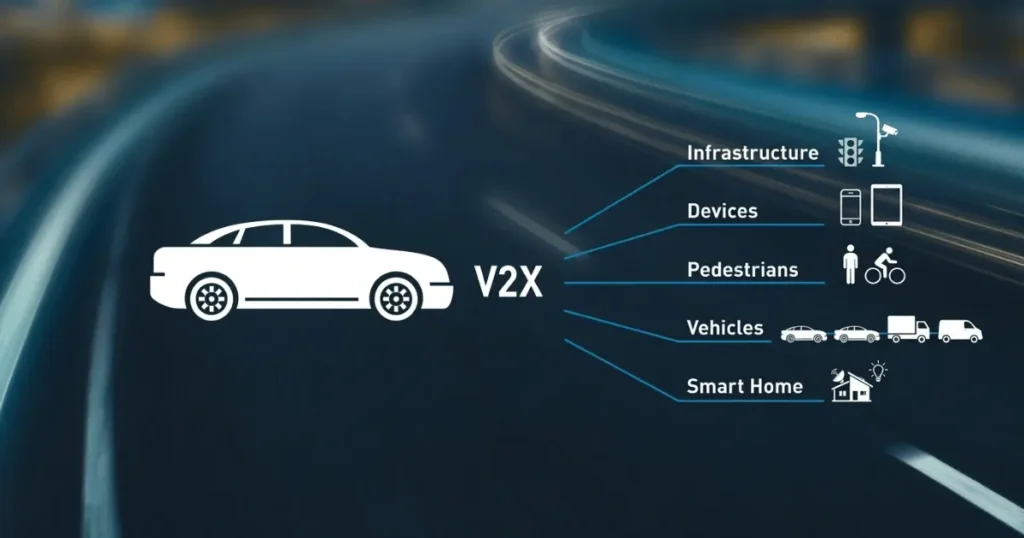
Vehicle-to-everything communication further enhances the intelligence of connected cars. By interacting with other vehicles, road infrastructure, and external devices, the car gains awareness beyond the driver’s line of sight. It can receive warnings about traffic signals, road hazards, or nearby vehicles, enabling quicker and safer decision-making. This feature becomes especially important as the industry moves toward semi-autonomous and fully autonomous driving systems.Security features also define connected cars in a significant way. With increased connectivity comes the need for strong cybersecurity measures. Modern vehicles use encrypted communication, secure authentication, and continuous monitoring to protect against unauthorized access. At the same time, features like vehicle tracking and geofencing help prevent theft and allow owners to monitor vehicle usage.
Role of Artificial Intelligence in connected cars
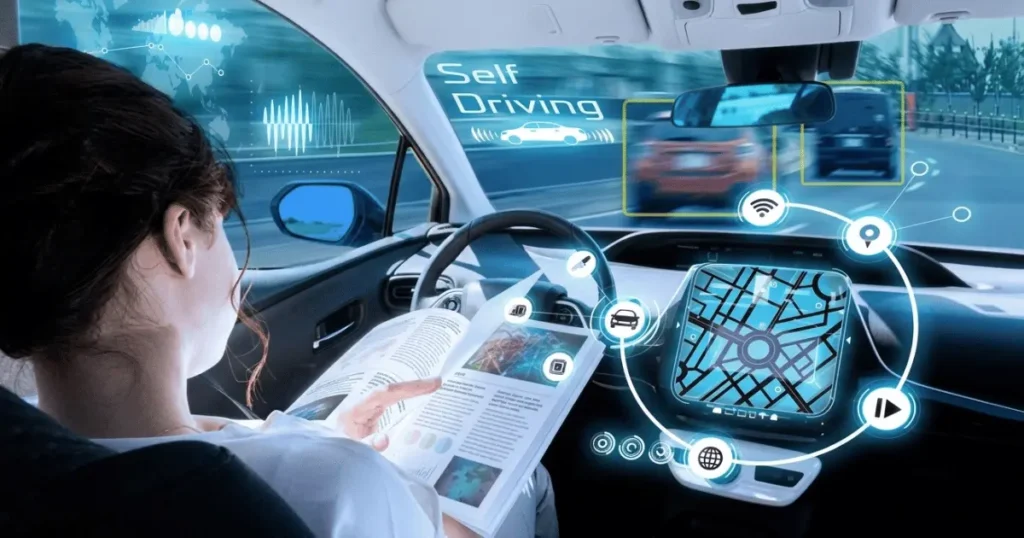
Artificial intelligence is the brain behind connected car technology. It transforms raw data into meaningful insights and enables cars to adapt to individual users.AI analyses driving patterns and learns user behaviour. If a driver frequently travels a certain route at a specific time, the system can automatically suggest it. If the driver prefers a particular cabin temperature or music playlist, the car adjusts settings accordingly.AI also plays a crucial role in safety systems. Advanced Driver Assistance Systems (ADAS) rely on AI to process data from cameras and sensors, enabling features like lane-keeping assist, adaptive cruise control, and collision avoidance.At the heart of this transformation lies the ability of AI to process vast amounts of data in real time. A connected car continuously gathers information from sensors, cameras, radar systems, and external networks. Without AI, this data would remain raw and largely unusable. AI algorithms analyze this flow of information instantly, identifying patterns such as driving behavior, traffic conditions, and potential hazards. This real-time interpretation allows the vehicle to respond intelligently rather than simply reacting to direct inputs.
One of the most visible applications of AI in connected cars is in advanced driver assistance systems and semi-autonomous driving features. AI enables the vehicle to recognize lanes, detect obstacles, interpret traffic signs, and monitor surrounding vehicles. It combines data from multiple sources through sensor fusion, creating a comprehensive understanding of the environment. This allows the car to assist with tasks like adaptive cruise control, lane keeping, automatic braking, and even hands-free driving in certain conditions. The system does not just follow pre-programmed rules; it continuously learns and improves its responses based on new data.AI also enhances the human-machine interaction inside the vehicle. Voice assistants powered by natural language processing allow drivers to communicate with their cars in a conversational manner. Instead of pressing buttons or navigating menus, the driver can simply speak commands to control navigation, climate, music, or communication functions. Over time, the AI adapts to the driver’s speech patterns, preferences, and habits, making interactions smoother and more personalized. This creates a more intuitive and less distracting driving environment.Predictive maintenance represents another powerful use of AI in connected cars. Traditional vehicles rely on fixed service schedules, but AI-driven systems monitor the condition of components continuously. By analyzing patterns in engine performance, vibration, temperature, and other parameters, AI can detect early signs of wear or failure. It predicts when a part is likely to fail and alerts the driver in advance. This proactive approach reduces unexpected breakdowns and helps maintain the vehicle in optimal condition.AI also plays a crucial role in optimizing navigation and traffic management. Connected cars receive live data about traffic flow, road conditions, and weather. AI processes this information to suggest the most efficient routes, taking into account not just current conditions but also predicted changes. For example, it can anticipate congestion based on historical patterns and real-time inputs, allowing drivers to avoid delays before they occur. This predictive capability improves travel efficiency and reduces fuel consumption.
Another important contribution of AI lies in driver monitoring and safety enhancement. Modern connected cars use cameras and sensors to observe driver behavior, detecting signs of fatigue, distraction, or drowsiness. AI analyzes facial expressions, eye movements, and steering patterns to determine whether the driver is fully attentive. If it detects a risk, the system can issue warnings or even take corrective actions. This feature significantly improves road safety by addressing human limitations.
AI extends beyond the individual vehicle and contributes to a broader connected ecosystem. In vehicle-to-everything communication, AI helps interpret data received from other vehicles and infrastructure. It prioritizes relevant information, filters out noise, and enables faster decision-making. For instance, if multiple vehicles share data about sudden braking ahead, AI can assess the situation and prepare the car to respond even before the driver notices the hazard.
Conclusion
Connected car technology represents a fundamental shift in the automotive industry. It has transformed cars into intelligent, connected ecosystems that enhance safety, convenience, and efficiency.In India, this transformation is happening at an impressive pace. As technology continues to evolve, connected cars will become an integral part of everyday life, shaping the future of mobility in ways we are only beginning to understand.For automotive content creators and bloggers, this topic offers immense potential. By exploring connected car technology in depth and presenting it in an engaging, human-written manner, you can build authority and attract a highly engaged audience.