When you press the accelerator in a car, you are not directly increasing speed. You are asking the engine to generate torque. Speed is only a result that comes later. The actual process of moving a vehicle begins with torque, which is the rotational force that turns the engine’s crankshaft and ultimately drives the wheels.
Torque is not just a technical specification mentioned in brochures. It is the force that allows a car to overcome resistance, start moving from rest, carry weight, and respond to driver input. Every moment your car is in motion, torque is being generated, transmitted, modified, and applied continuously. To truly understand what torque does in a car, you need to follow its complete journey from the moment fuel burns inside the engine to the moment the tyres push against the road.
Torque Generation Inside the Engine
Rotation
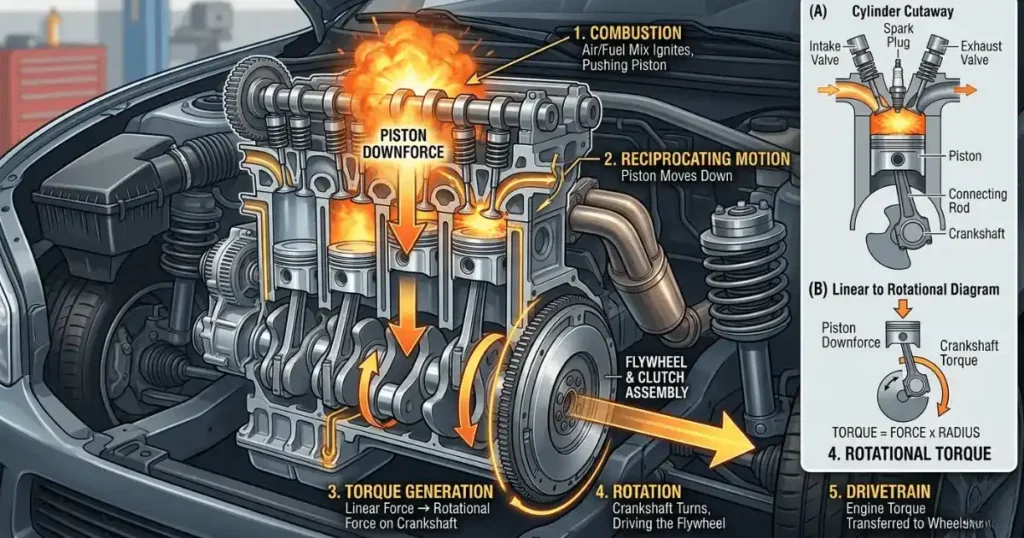
The process of torque generation begins inside the engine cylinder, where combustion takes place. When the air-fuel mixture ignites, it creates a rapid expansion of gases. This expansion generates extremely high pressure, which acts directly on the surface of the piston. At this stage, the force produced is purely linear, meaning it pushes the piston downward in a straight line.
However, a car does not move with linear motion inside the engine. It requires rotational motion to turn the wheels. This conversion from linear force to rotational force is achieved through the design of the crankshaft. The piston is connected to the crankshaft via a connecting rod, and the crankshaft has an offset section known as the crank throw. This offset creates a lever arm distance from the centre of rotation.
As the piston moves downward due to combustion pressure, the connecting rod transfers this force to the crankshaft at an angle. Because of the crankshaft’s offset geometry, this force creates a turning effect, which is torque. The amount of torque generated depends on how much force is applied to the piston and how far that force is acting from the centre of rotation. Higher combustion pressure results in greater force, and a longer crank throw increases leverage, both contributing to higher torque output.
At this stage, torque exists as rotational energy at the crankshaft. This is the primary source of motion in the entire vehicle, but it is still not directly usable in this form. It needs to be stabilised and controlled before it can be transmitted to the wheels.
Crankshaft Rotation and the Role of the Flywheel in smoothingTorque
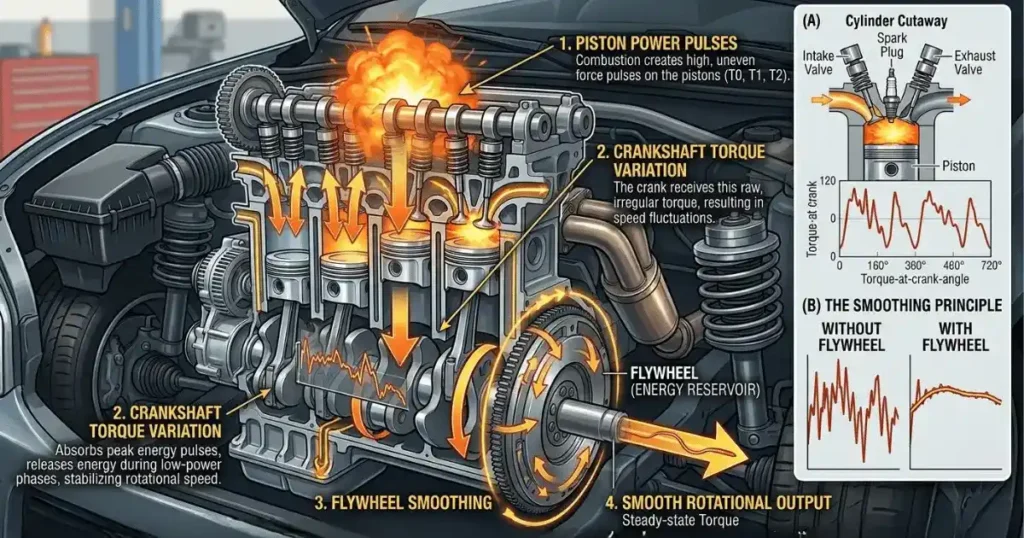
The torque generated inside the engine is not continuous. It occurs in pulses because combustion happens only during the power stroke of each cylinder. If the engine had only one cylinder, the output would be extremely uneven, with sudden bursts of force followed by periods of inactivity.
To create smooth and usable torque, modern engines use multiple cylinders arranged in a sequence known as the firing order. Each cylinder produces torque at slightly different times, which helps overlap the power delivery. However, even with multiple cylinders, the torque output is still not perfectly smooth.
This is where the flywheel plays a crucial role. The flywheel is a heavy rotating disc attached to the crankshaft. Its mass allows it to store rotational energy. When a cylinder produces excess energy during the power stroke, the flywheel absorbs some of that energy. During non-power strokes, the flywheel releases stored energy, keeping the crankshaft rotating smoothly.
This process transforms pulsating torque into a more consistent and stable rotational motion. Without the flywheel, the engine would produce vibrations and jerky movement, making the car difficult to drive.
Torque Transformation Inside the Gearbox
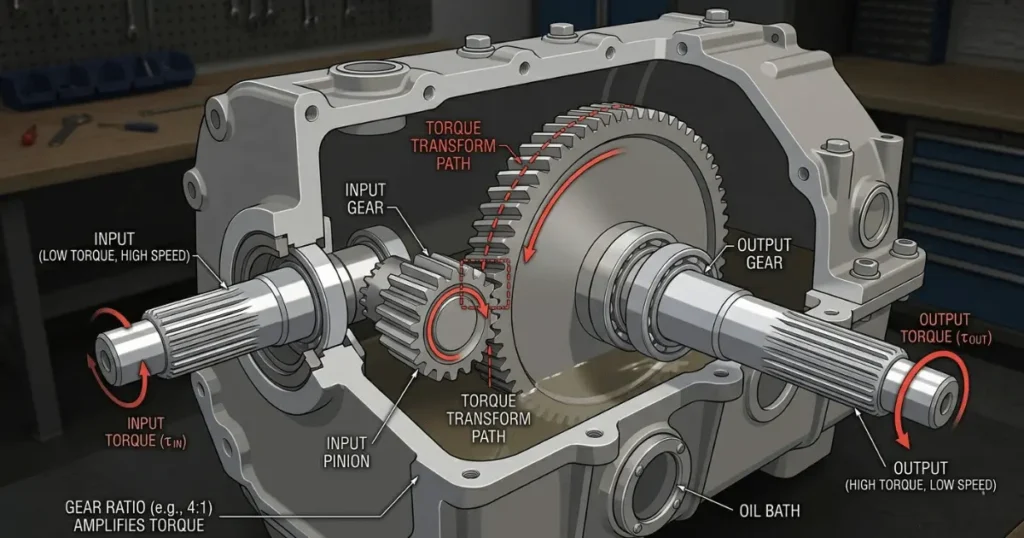
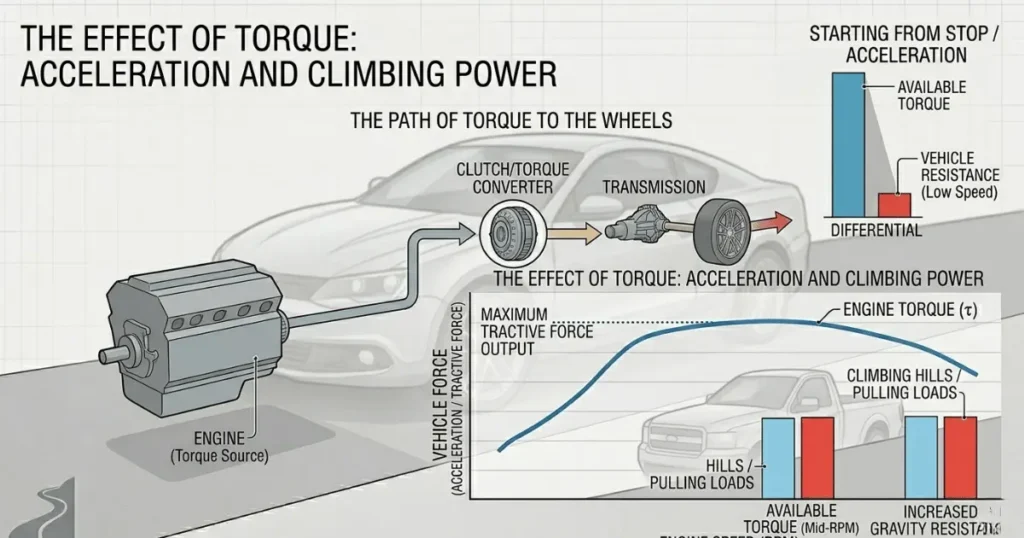
Once torque leaves the engine, it enters the transmission system, commonly known as the gearbox. The torque produced by the engine is not always suitable for driving conditions. A car requires different levels of torque depending on whether it is starting from rest, climbing a hill, or cruising at high speed.
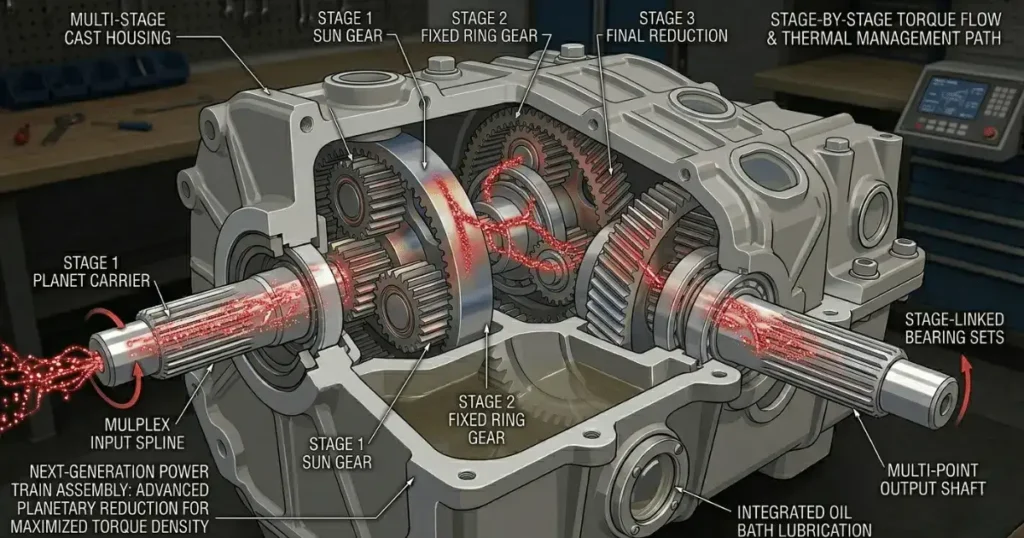
The gearbox solves this problem by using gear ratios. These ratios determine how engine torque is modified before reaching the wheels. In lower gears, the gearbox increases torque while reducing speed. This is achieved by using gears of different sizes that change the rotational relationship between the input shaft and output shaft.
When the car is in first gear, the output shaft rotates slower than the engine, but the torque is significantly increased. This allows the car to move from a standstill and overcome inertia. As the car gains speed, higher gears are selected. In these gears, torque is reduced while speed increases, making the car more efficient at higher velocities.
The gearbox does not create torque. It redistributes and amplifies it based on mechanical leverage. This ability to control torque is what allows a single engine to perform effectively under a wide range of driving conditi,
torque Transfer Through the Drivetrain and Differential
After passing through the gearbox, torque travels through the drivetrain toward the wheels. Depending on the vehicle layout, this may involve a driveshaft that carries torque to the rear axle or directly to the front wheels.
Before reaching the wheels, torque passes through the differential. The differential is a mechanical system that distributes torque between the left and right wheels. It allows the wheels to rotate at different speeds, which is essential when the car is turning.
When a vehicle takes a turn, the outer wheel travels a longer distance than the inner wheel. Without a differential, both wheels would be forced to rotate at the same speed, causing tyre slip and instability. The differential ensures that torque is distributed in a way that maintains traction and smooth handling.
At this stage, torque is now properly managed and ready to be applied at the wheels.
Torque at the wheels
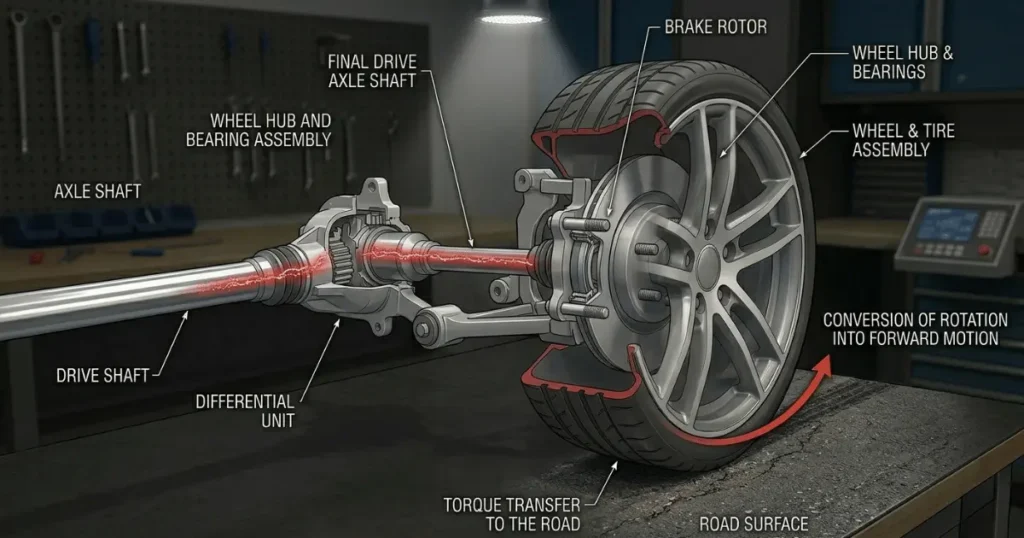
When torque reaches the wheels, it finally begins to perform its most important function—moving the car. However, torque alone cannot move the vehicle unless it interacts with the road surface.
As the wheels rotate due to torque, the tyres push backward against the road. According to Newton’s third law, the road pushes forward against the tyres with an equal and opposite force. This forward force is what propels the car.
The effectiveness of this process depends on traction, which is the friction between the tyre and the road. If the torque applied to the wheels exceeds the available traction, the tyres will spin without moving the car effectively. This is known as wheel spin. On the other hand, if traction is sufficient, the torque is converted into forward motion smoothly.
This interaction explains why cars with high torque require good tyres and traction control systems. It also explains why driving conditions such as wet roads or loose surfaces can affect how effectively torque is used.
Torque Versus Resistance in Real Driving Conditions
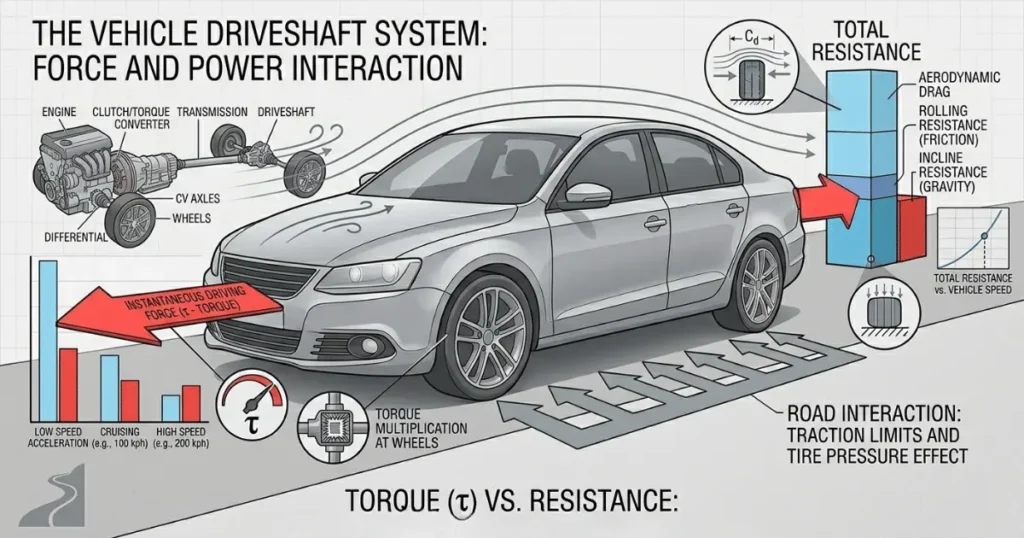
In real-world driving, torque constantly works against various resistance forces. These include the weight of the vehicle, gravitational force when climbing hills, rolling resistance from tyres, and air resistance at higher speeds.
When a car starts moving from rest, torque must overcome inertia. When climbing a hill, torque must counteract gravity. When carrying passengers or cargo, torque must move additional mass. At higher speeds, torque must overcome aerodynamic drag.
The balance between torque and resistance determines how the car performs. If torque is greater than resistance, the car accelerates. If both are equal, the car maintains constant speed. If resistance exceeds torque, the car slows down.
This is why vehicles with higher torque feel more effortless to drive. They can handle varying conditions without requiring the engine to work excessively hard.
Torque Behaviour across Engine Speed
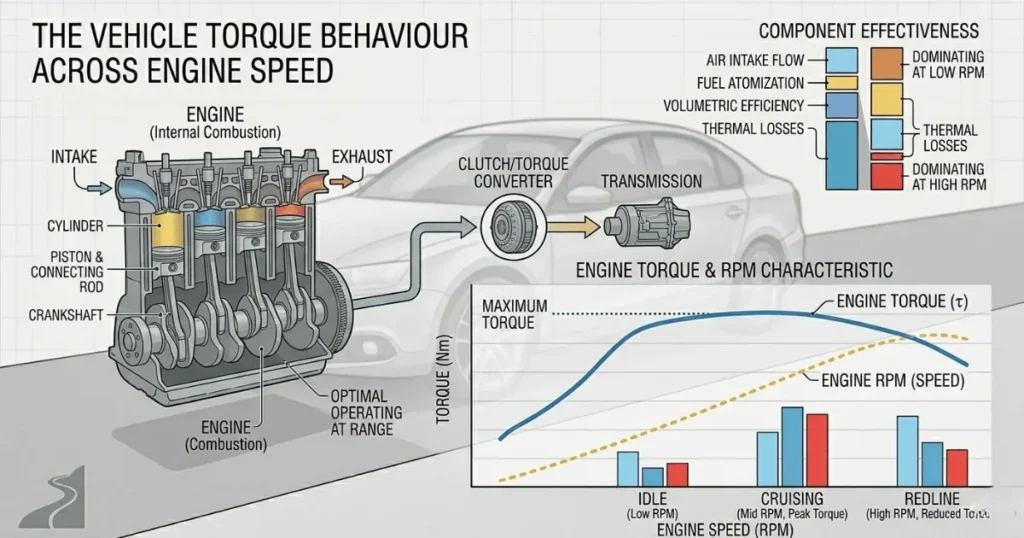
Torque is not constant across all engine speeds. It varies depending on the engine’s design and operating conditions. Each engine has a torque curve that shows how torque changes with RPM.
At lower RPMs, some engines produce high torque, making them suitable for tasks like towing and city driving. Diesel engines are known for this characteristic because they generate strong torque at low speeds.
Petrol engines typically produce peak torque at higher RPMs. This means they require more revving to deliver maximum performance. However, they often provide smoother operation and better high-speed capability.
Understanding this variation helps explain why different cars feel different to drive. It also highlights why torque characteristics are more important than peak numbers alone.
conclusion: Torque Is the Complete Force Chain of Motion
Torque is not just a value printed in a specification sheet. It is the complete chain of mechanical events that begins with combustion and ends with the movement of the car. From the moment fuel ignites inside the cylinder, torque is generated, shaped, transmitted, and applied through multiple systems working in perfect coordination.
It starts as pressure inside the cylinder, becomes rotational force at the crankshaft, is modified by the gearbox, distributed by the differential, and finally applied at the wheels to push against the road. Every stage in this process is essential, and any disruption can affect the performance of the entire vehicle.
In real driving conditions, torque determines how a car feels, how it responds, and how effectively it performs under different loads and terrains. It is the true measure of usable power, the force you experience every time you accelerate, climb, or carry weight.
Once you understand torque at this level, you begin to see a car not just as a machine but as a system where physics, engineering, and motion come together to create a seamless driving experience.